
Balcony solar system regulations for 2026 in Germany: What is permitted?
In short: In Germany, a balcony solar system may have an inverter output of up to 800 VA and a module output of up to 2,000 Wp. You must register it with Marktstammdatenregister within one month; you do not need to notify the grid operator. The old meter may continue to run until it is replaced, and both tenants and flat owners are entitled to permission.
Contents
How big can a balcony solar system be?
This page describes the rules in Germany. A brief overview for Austria and Luxembourg is provided at the end.
The law refers to balcony solar systems as ‘plug-in solar devices’: modules, inverters, connection cables and plugs for the flat’s electrical circuit. Simplified rules apply to these, provided two limits are observed. The inverter must not exceed 800 volt-amperes (VA), commonly referred to as ‘800 watts’ in everyday language. The modules must not exceed a combined peak power of 2,000 watts (Wp).
Both limits apply to all devices connected to the same supply point – that is, the connection point from which you draw electricity. A rooftop PV system is not included in this calculation.
It is intentional for the module output to exceed the inverter’s capacity: with four modules totalling 2,000 Wp, the inverter comes closer to its 800 VA limit in the mornings, evenings and on cloudy days. You can find out how much electricity this generates per year in the guide Balcony Solar System: Yield.
| Your project | Is it permitted as a balcony solar system? | Why |
|---|---|---|
| 2 modules at 930 Wp, 800 VA inverter | Yes | Both limits are met |
| 4 modules with 2,000 Wp, 800 VA inverter | Yes | Exactly at both limits; not compliant with standards when using a Schuko plug, see Plugs |
| Inverter that can be set to more than 800 VA | No | A standard PV system even when throttled: connection by a qualified electrician, registration with the grid operator |
| 5 modules at 2,300 Wp, 800 VA inverter | No | Over 2,000 Wp |
| Balcony solar system alongside a rooftop system | Yes | Not included in the total |
Some micro inverters can be set to more than 800 VA by a switch, an app or software. They do not count as a balcony solar system, even if you throttle them to 800 VA: according to the Federal Network Agency, the highest adjustable output is what counts. Sets with four modules can be found under Balcony Solar System 2000 Watt; check the inverter output there.
Sources: Section 8(5a) and Section 3(43) of the EEG, Federal Network Agency, balcony solar systems, checked on 7 November 2026
- Inverter capacity, total for all devices connected to a single supply point1
- 800 VA
- Source: Section 8(5a) of the EEG
- Module power, all devices combined2
- 2.000 Wp
- Source: Section 8(5a) of the EEG
- Deadline for entry in the Market Master Data Register (Marktstammdatenregister)3
- 1 month
- Source: Section 5(5) of the MaStRV
- Notification to the grid operator4
- None
- Source: Section 8(5a), second sentence, of the EEG
- Section 8(5a) of the EEG
- Section 8(5a) of the EEG
- Section 5(5) of the MaStRV
- Section 8(5a), second sentence, of the EEG
Do I need to register a balcony solar system?
Yes, with the Federal Network Agency’s Market Master Data Register (Marktstammdatenregister) within one month of commissioning. You cannot be required to register with the grid operator.
Previously, there were two notifications: one to the grid operator and one to the register. Since the Solar Package I (May 2024), only the register entry remains. This applies provided the system has a maximum of 800 VA and 2,000 Wp. The grid operator may require a notification for a storage unit; see balcony solar system with storage.
How to register your balcony solar system
Connecting
Set up your balcony solar system and plug it in. The day it supplies electricity for the first time is the date of commissioning.
Create an account
Within one month, create a user account at marktstammdatenregister.de and register as the system operator.
Register your balcony solar system
Since 1 April 2024, only a few details are required: location, name of the system, commissioning date, module output, inverter output and your electricity meter number.
Done
The grid operator receives the data from the register. If a new meter is required, the metering point operator will replace it without you having to request it.
Sources: Section 8(5a) of the EEG, Section 5(5) of the MaStRV, Registration guide for the Market Master Data Register, checked on 7 November 2026
What applies to a balcony solar system with storage?
The storage unit is entered in the Market Master Data Register (Marktstammdatenregister) as a separate unit; the easiest way is to do this at the same time as registering the balcony solar system. You can also add it later.
A storage unit such as the Growatt NOAH 2000 is situated between the modules and the inverter. During the day, it stores any electricity that the flat does not consume and later feeds it back to the flat via the inverter. The maximum power flowing into the domestic grid remains 800 VA.
The exemption for plug-in solar devices does not apply to storage systems. According to the EEG/KWKG Clearing House, under current legislation, storage systems are “not covered by the exemption for plug-in solar devices pursuant to Section 8(5a) of the EEG 2023 …, even if they are sold in combination with plug-in solar devices”. Accordingly, even “plug-and-play storage-solar system combinations” do not fall under the definition of a plug-in solar system. Your grid operator may therefore require you to register the storage system with them as well. It is best to check with them before connection. The draft of the new EEG includes storage systems in the definition and does not apply the limits to them (see 2027). To find out whether a storage system is worthwhile for you, see Balcony solar system with storage: when does it make sense?
Sources: Market Master Data Register, Guidance on Balcony Solar Systems and Storage Systems, Section 3(43) EEG, checked on 7 November 2026; EEG/KWKG Clearing House, Frequently Asked Legal Question 1, as at 9 October 2026, checked on 8 November 2026
What happens to the electricity meter?
You may start using your existing meter straight away, even if an old disc-type meter runs backwards. The metering point operator will replace it of their own accord.
An old Ferraris meter with a disc can run backwards if the balcony solar system supplies more electricity than the flat currently needs. This is permitted until the meter is replaced. The metering point operator will then, without your request, install a modern metering device that counts consumption and grid feed-in separately, or a smart metering system.
According to the Federal Network Agency, this takes place ‘without delay’, i.e. within weeks to a few months, not years. A digital meter that already counts in both directions does not need to be replaced.
Sources: Section 10a(2) and (3) of the EEG, Federal Network Agency, balcony solar systems, checked on 7 November 2026
How many balcony solar systems are you allowed to have?
Under the EEG, as many as you like, provided their combined output remains below 800 VA and 2,000 Wp. The product standard, however, provides for only one unit per household.
The limits do not apply per unit, but to all units connected to the same supply point. Anyone wishing to install more should have a standard PV system installed by a qualified electrician and register it with the grid operator.
| Units | Inverters combined | Result under the EEG |
|---|---|---|
| 1 unit at 800 VA | 800 VA | Balcony solar system |
| 2 units, each with 400 VA | 800 VA | Balcony solar system |
| 2 units, each with 600 VA | 1,200 VA | Standard PV system |
| 2 appliances, each with 800 VA | 1,600 VA | Standard PV system |
According to the explanatory memorandum to the Solarpaket I, the point of consumption corresponds in most cases to the flat or house; the Federal Network Agency refers to the market location from which you obtain your electricity. The product standard also requires a notice on the plug stating that only one plug-in solar device may be connected per household: several units on one circuit can overload the wiring. Have a second unit connected by a qualified electrician.
Sources: Federal Network Agency, balcony solar systems, Parliamentary Paper 20/8657, p. 83, DKE, FAQs on DIN VDE V 0126-95, checked on 7 November 2026
Schuko or Wieland: Which plug is permitted?
The law does not specify a particular plug. The product standard of December 2025 permits the Schuko plug for module power up to 960 Wp; above this, the Wieland plug on an energy socket installed by a qualified electrician.
For a long time, there was debate over whether a balcony solar system could be connected to a standard domestic socket (Schuko). Since December 2025, there has been a dedicated product standard: DIN VDE V 0126-95. It is a pre-standard: not a law, but a recognised technical regulation. It does not affect devices that are already in operation.
Plugs compliant with DIN VDE V 0126-95
Sources: VDE, product standard for plug-in solar devices, DKE, interpretation of the standard DIN VDE V 0126-95, DKE, FAQs on DIN VDE V 0126-95, checked on 7 November 2026
Balcony solar systems in rented flats and in owners’ associations
Since 17 October 2024, tenants and flat owners have been entitled to have a balcony solar system permitted.
Tenants must ask the landlord for permission. The landlord must agree, unless the balcony solar system cannot reasonably be expected of them, even taking the tenant’s interests into account. You can undertake to pay an additional security deposit. Any agreement that deviates from this to the detriment of the tenant is invalid.
Flat owners have the same right vis-à-vis the owners’ association. As a rule, the owners’ meeting no longer decides on whether to allow it, but on how it is to be implemented, for example where and how it is mounted. Only projects that fundamentally alter the property or unfairly disadvantage an owner remain excluded.
Before purchasing, ask whether there are any installation guidelines for the building. The guide Mounting Brackets for Solar Panels describes brackets for railings, walls and roofs.
Sources: Section 554 of the German Civil Code (BGB), Section 20(2)(5) and (4) of the German Condominium Act (WEG), checked on 7 November 2026
Feed-in tariff, VAT and subsidies
No feed-in tariff
Electricity that you do not consume yourself is fed into the grid without any remuneration. Only then do the simplified rules apply. Anyone wishing to receive the standard feed-in tariff forfeits these simplified rules.
Source: Section 21(1) of the EEG, checked on 7 November 2026
No curtailment
The Solarspitzengesetz (Peak Solar Act) of February 2025 limits the grid feed-in from new PV systems without control technology to 60 per cent. Balcony solar systems up to 800 VA and 2,000 Wp are exempt from this.
Source: Section 9(1) and (2) of the EEG, checked on 7 November 2026
0% VAT
Photovoltaic systems and their essential components are subject to a VAT rate of 0 % (zero rate) under the conditions set out in Section 12(3) of the German VAT Act (UStG). Please indicate during the ordering process whether these conditions apply. The Federal Ministry of Finance explicitly mentions balcony solar systems in this context. For more information, see VAT on photovoltaics.
Source: Section 12 of the German Value Added Tax Act (UStG), checked on 7 November 2026
Subsidies
There is no federal grant available. Some federal states and cities offer funding for balcony solar systems, though in some cases an application must be submitted before purchase. Current schemes are listed under Balcony Solar System Funding 2026.
What is planned for 2027?
The Federal Government has presented a draft of a new Renewable Energy Sources Act (EEG), which is due to come into force on 1 January 2027. It has not yet been adopted. For balcony solar systems, it provides as follows:
- A storage unit connected to the same inverter will form part of the balcony solar system; the limits of 800 VA and 2,000 Wp do not apply to it.
- Grid feed-in will remain without remuneration, and the exemption from curtailment will remain in place.
Status of the legislative process: first reading in the Bundestag on 24 September 2026, followed by consideration in the committees. We will update this section as soon as the law has been passed.
Sources: Federal Ministry for Economic Affairs, draft bill of 29 July 2026, German Bundestag, first reading, checked on 7 November 2026
What are the rules in Austria and Luxembourg?
Austria
- Up to 0.8 kW per installation without a licence and without a dedicated metering point.
- Notify the grid operator two weeks before commissioning.
- Grid feed-in via a permanently installed socket, provided the manufacturer authorises this; no extension leads or multi-socket adaptors.
Sources: Electricity Industry Act, Federal Law Gazette I No. 91/2025, oesterreich.gv.at, E-Control, checked on 7 November 2026
Luxembourg
- Inverter capacity of up to 799 W is permitted.
- A Wieland plug is recommended but not mandatory.
- No subsidy is available under the Klimabonus scheme. Please check with your local authority to find out whether they require a permit or declaration.
Source: Klima-Agence, checked on 7 November 2026
Balcony solar kits with 800 VA by default
The kits have a rated power of 800 VA on the domestic mains supply. The kit with 930 Wp without a storage unit remains below the 960 Wp limit for the Schuko plug; the kit with NEXA 2000 utilises the full 2,000 Wp. The NEXA 2000 delivers 800 W as standard; you can set the NEXA 2000 to up to 1,000 W in the app (Power+); according to the Federal Network Agency, the highest settable power rating is the decisive factor. The NOAH 2000 and NEXA 2000 storage units are also available individually for retrofitting.
Kits with 800 VA by default

Growatt · JA Solar · Item no. PV10710555Growatt · PV10710555
PV Balcony System With Growatt NEO 800 Micro Inverter + JA Solar Solar Module
- 0.93 kWp
- 0.8 kW
In the set: 2 × Module 465 W · Micro inverter
-

-

incl. 0 % VAT for system operators*
In stock · plus shipping costs
Plus shipping costs

Growatt · JA Solar · Item no. PV10710097Growatt · PV10710097
- 0.93 kWp
- 2.05 kWh
- 0.8 kW
In the set: 2 × Module 465 W · Storage · Micro inverter
-
-

-
incl. 0 % VAT for system operators*
In stock · plus shipping costs
Plus shipping costs

Growatt · JA Solar · Item no. PV10710680Growatt · PV10710680
PV Balcony System With NEXA 2000 Battery + JA Solar Glass-Glass Bifacial Full Black Solar Module
- 2 kWp
- 2.05 kWh
- 0.8 kW
In the set: 4 × Module 500 W · Storage
-

-

incl. 0 % VAT for system operators*
In stock · plus shipping costs
Plus shipping costs

Growatt · NOAH2000Growatt · NOAH2000
Growatt NOAH 2000 Plug & Play Battery
- 2.05 kWh
- Battery with separate micro-inverter
- Low Voltage
incl. 0 % VAT for system operators*
In stock · Free shipping
Free shipping

Growatt · NEXA 2000Growatt · NEXA 2000
Growatt NEXA 2000 Plug & Play Battery
- 2.05 kWh
- Battery with built-in inverter
- Low Voltage
incl. 0 % VAT for system operators*
In stock · Free shipping
Free shipping
* Section 12(3) UStG: only with the operator declaration at checkout, otherwise plus 19 % VAT.
You can find further sets under Balcony solar systems without storage, Balcony solar systems with storage and Storage systems for balcony solar systems.
Frequently asked questions
How many watts can a balcony solar system have?
800 VA at the inverter – commonly referred to as ‘800 watts’ – and 2,000 Wp of module power. Both values apply collectively to all devices connected to the same supply point.
Is a 1,200-watt balcony solar system permitted?
Yes, with a module output of 1,200 Wp, provided the inverter delivers no more than 800 VA. An inverter that can be set to 1,200 VA makes it a standard PV system, even when it runs throttled.
Do I have to register my balcony solar system with the grid operator?
No. Since May 2024, it has been sufficient to register with the Market Master Data Register (Marktstammdatenregister) within one month; the grid operator may not require any additional notification.
Do I need to register a storage system separately?
Yes, as a separate entry in the market master data register. This can be done in the same process as for the balcony solar system. The exemption for plug-in solar devices does not apply to storage systems according to the EEG/KWKG clearing house; the grid operator may therefore also require a separate registration with them.
Can I operate two balcony solar systems?
Under the EEG, yes, provided that both together do not exceed 800 VA and 2,000 Wp; two units of 800 VA each is too much. The product standard provides for only one unit per household so that no circuit is overloaded. Have a second unit connected by a qualified electrician.
Can my meter run backwards?
Yes, until the metering point operator replaces it with a meter that measures consumption and grid feed-in separately. You do not need to request this replacement.
Do I need a special socket?
For module power ratings up to 960 Wp, a standard domestic socket is sufficient under the product standard, provided the unit has the necessary safety features. Above this, the standard specifies an energy socket for the Wieland plug, installed by a qualified electrician. The law itself does not prescribe any particular type of plug.
Does a balcony solar system supply power during a power cut?
This requires a storage unit with its own output for emergency operation. The Growatt NEXA 2000 has such an output rated at up to 800 W. Find out more under Backup power with a PV system.
This page summarises the legal situation and is not a substitute for legal advice. We review it monthly.
Sources
- Section 3 of the EEG (plug-in solar device, No. 43), as of 07.11.2026
- Section 8 of the EEG (Limits and notification, paragraph 5a), as of 07.11.2026
- Section 10a of the EEG (Meters), as of 07.11.2026
- Market Master Data Register Ordinance (Section 5(5)), as of 07.11.2026
- Federal Network Agency, balcony solar systems, as of 07.11.2026
- Federal Network Agency, simplified registration from 1 April 2024, as of 07.11.2026
- Marktstammdatenregister (Market Master Data Register), registration guide for balcony solar systems, as of 07.11.2026
- Marktstammdatenregister (Market Master Data Register), guidance on balcony solar systems and storage systems, as of 07.11.2026
- Clearingstelle EEG/KWKG, frequently asked legal question 1 (plug-in solar devices), as of 08.11.2026
- German Bundestag, Parliamentary Paper 20/8657 (Explanatory Memorandum to Solarpaket I), as of 07.11.2026
- VDE, Product standard for plug-in solar devices (14 November 2025), as of 07.11.2026
- DKE, FAQs on DIN VDE V 0126-95 (17 December 2025), as of 07.11.2026
- DKE, interpretation of the standard DIN VDE V 0126-95 (17 December 2025), as of 07.11.2026
- Section 554 of the German Civil Code (BGB), as of 07.11.2026
- Section 20 of the German Condominium Act (WEG), as of 07.11.2026
- Section 21 of the EEG (purchase free of charge), as of 07.11.2026
- Section 9 EEG (Solarspitzengesetz, Exceptions), as of 07.11.2026
- Section 12 of the German Value Added Tax Act (UStG), as of 07.11.2026
- Federal Ministry for Economic Affairs, Draft Bill on the EEG and the Electricity Sector (29 July 2026), as of 07.11.2026
- German Bundestag, first reading 24 September 2026, as of 07.11.2026
- Austria, Electricity Industry Act (Federal Law Gazette I No. 91/2025), as of 07.11.2026
- oesterreich.gv.at, Self-generation of electricity, as of 07.11.2026
- E-Control: FAQs on mini-PV systems, as of 07.11.2026
- Klima-Agence Luxembourg, Electricity from your own balcony, as of 07.11.2026
Read on

Balcony power plant subsidies 2026: federal, state and city schemes
There is no federal grant for balcony power plants. Funding is currently available in two federal states (Hamburg and Mecklenburg-Western Pomerania) and in nine cities (Darmstadt, Düsseldorf, Freiburg im Breisgau, Gelsenkirchen, Kassel, Leipzig, Mainz, Marburg and Munich); some schemes are only available to specific groups, such as tenants or low-income households, and some require an application to be submitted before purchase. A further 19 schemes have been fully utilised, discontinued or put on hold. Nationwide, simplified rules apply to plug-in solar devices with an inverter capacity of up to 800 VA and a module output of up to 2,000 Wp, and every balcony power plant is entered in the market master data register. Photovoltaic systems and their essential components are subject to a VAT rate of 0 % (zero rate) under the conditions set out in Section 12(3) of the German Value Added Tax Act (UStG).

Balcony power plant with storage: When does it make sense?
A storage unit generates no extra electricity. It stores what the panels supply at midday beyond the flat’s current needs and releases it in the evening. This makes sense if there is a regular surplus and electricity is needed in the evening. According to the Consumer Advice Centre, storage becomes more attractive the higher the consumption and the larger the balcony power plant.
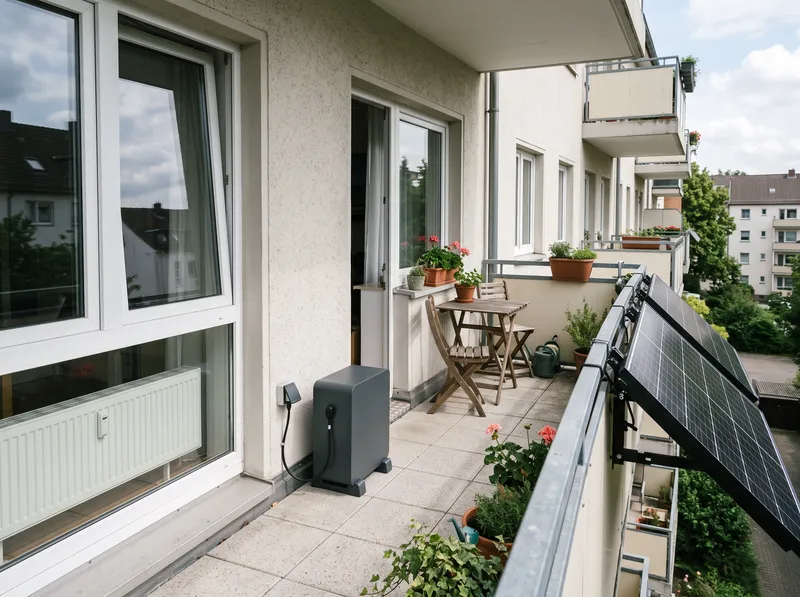
Growatt NOAH 2000 or NEXA 2000: What is the difference?
According to the data sheet, both storage units have a capacity of 2,048 Wh and can be expanded to 8,192 Wh. The NEXA 2000 has a built-in inverter, four module inputs and a connection for loads in the event of a power cut; it is suitable if you are buying a new system, wish to connect four modules directly or want to power individual devices during a power cut. The NOAH 2000 works with a separate micro inverter such as the Growatt NEO 800M-X and is suitable if you have separate storage and inverter units or wish to continue using an existing Growatt NEO.